
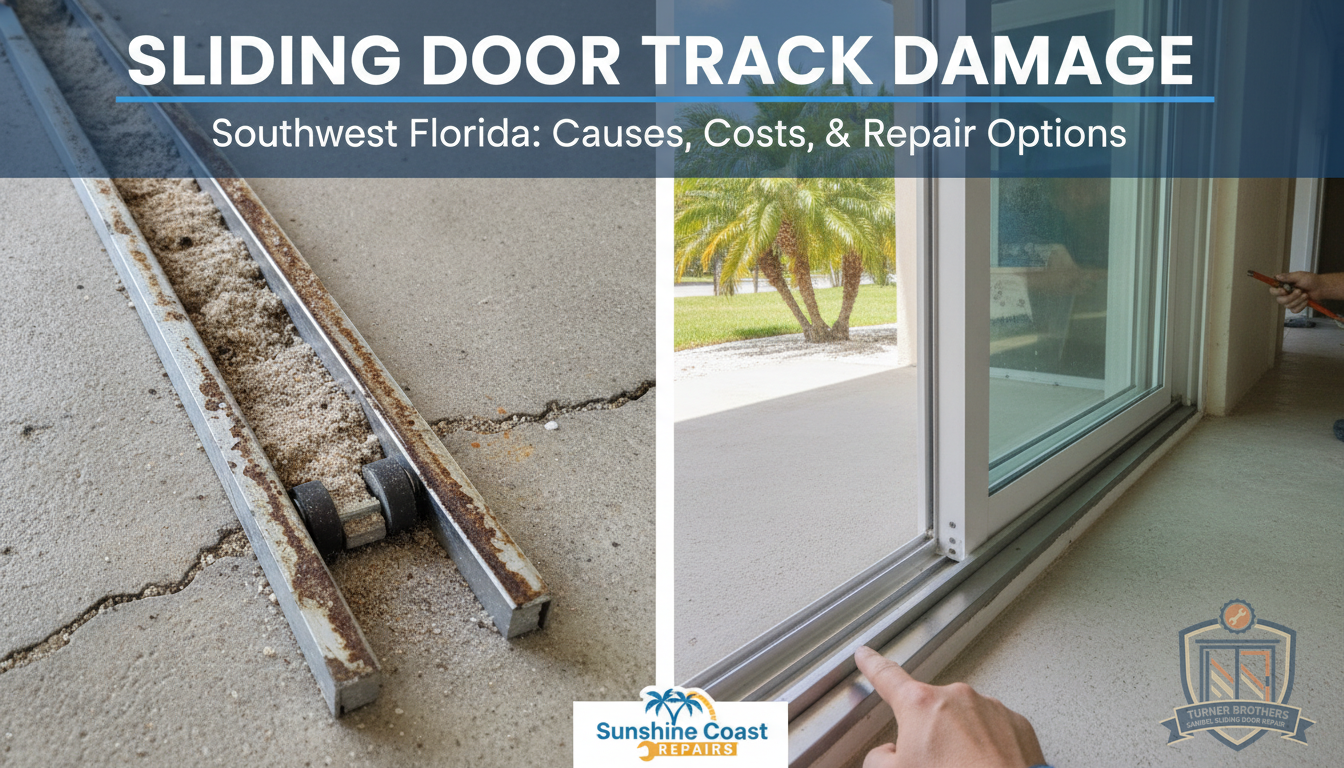
The bottom track of a sliding glass door looks simple — a shallow aluminum channel bolted to the sill — but it is one of the hardest-working and most abuse-prone components in any Southwest Florida home. It bears the full rolling weight of the glass panel thousands of times a year, collects every grain of sand and shell fragment that wanders across your floor, and sits fully exposed to the salt air, rain, and storm surge events that define life on Florida's Gulf Coast barrier islands.
At Turner Brothers Sanibel Sliding Door Repair, track problems are among the most frequent calls we receive from homeowners across Sanibel, Fort Myers Beach, Cape Coral, and the surrounding Lee County communities. This guide walks through the most common causes of track damage, how to tell whether your track can be repaired or needs full replacement, and what the process looks like when our team arrives.
What Causes Sliding Door Track Damage in Coastal Florida?
Track damage in Southwest Florida almost always traces back to one or more of the following sources:
- Sand and shell debris: Sanibel's beaches produce some of the finest shelling in the world, and that shell grit follows residents indoors. Fragments trapped in the track channel roll under the door's wheels with every pass, gouging the track surface and grinding flat spots into rollers simultaneously.
- Salt air corrosion: Even aluminum track — which is naturally corrosion-resistant — develops pitting and oxidation over time in a salt-laden environment. Once the track surface is pitted, roller wheels catch on the rough spots and accelerate wear on both components.
- Storm surge and water infiltration: Sanibel's low elevation means that even moderate tropical weather events can push water across thresholds. Water that pools in the track channel and evaporates leaves mineral and salt deposits that further corrode and degrade the metal.
- Physical impact and foot traffic: Heavy foot traffic, furniture legs rolling over the track, and children or pets catching the track edge with weight can dent or bend the channel walls, causing the door to bind mid-travel.
- Hurricane damage: High winds and flying debris can deform track sections beyond what can be straightened, and storm surge events may shift the track off the sill entirely, requiring full removal and reinstallation.
Repair vs. Replace: How We Decide
Not every damaged track needs to be replaced entirely. Our technicians assess the track's condition along its full length before making a recommendation. Here is the general framework we use:
- Minor dents and isolated bends: Small deformations in aluminum track can often be carefully reshaped with a track-straightening tool, especially if the damage is confined to a short section and the surrounding metal is otherwise sound.
- Surface pitting and corrosion: Light surface oxidation can be addressed with cleaning and a corrosion-inhibiting treatment. Deeper pitting that has created a rough rolling surface is harder to correct and usually warrants replacement of that section.
- Full-length deformation or severe corrosion: When damage extends across most of the track or the metal has corroded through, full replacement is the only solution that will provide lasting results. Attempting to patch a severely compromised track leads to repeat service calls and ongoing door problems.
- Track that has shifted off the sill: Any track that has separated from or shifted on the sill needs to be removed, the sill surface cleaned and assessed, and the track re-secured or replaced before the door is re-hung.
We also evaluate the upper track and guide channels during every track service call, since warping in the upper channel — common after storm events — can be just as disruptive to door operation as lower track damage. Our sliding door track repair and replacement service covers both.
The Connection Between Track Damage and Roller Wear
Track damage and roller wear are closely linked — each accelerates the other. A rough, pitted track grinds down roller wheels. Worn flat rollers, in turn, bounce and catch in the track channel instead of rolling smoothly, accelerating surface damage. This is why we inspect both components together and recommend addressing them in the same visit when both show signs of wear.
If your door is grinding, sticking, or running unevenly, our roller replacement service is often paired with track service to deliver a complete restoration. Replacing rollers on a damaged track — or resurfacing a track without replacing worn rollers — produces disappointing results that require a second visit far sooner than necessary.
How Track Damage Affects Your Home's Weather Protection
A deformed or corroded track does more than make the door hard to open. It compromises the door's ability to seat properly in its frame, creating gaps that allow conditioned air to escape, rain to enter, and insects to pass through. For Sanibel homeowners, a door that does not seal completely against the sill is an open invitation to moisture damage, elevated cooling costs, and the full population of Gulf Coast insects that would otherwise stay outside.
After every track repair or replacement, we re-hang the door and test it against the full perimeter seal — including the weatherstripping — to confirm that the closure is tight and water-resistant before we leave.
What to Do While You Wait for Service
If your track is damaged but the door is still functional, there are a few steps you can take to slow further deterioration until your service appointment:
- Sweep and vacuum the track channel regularly to remove sand, shell grit, and debris. Use a stiff brush to dislodge material packed into the corners of the channel.
- Avoid forcing a sticking door. If the door catches, do not push harder — lifting the leading edge slightly and then sliding gently often gets it moving without grinding the track further.
- Do not pour water into the track to clean it if there is existing rust or corrosion; water accelerates the process. A dry brush followed by a vacuum is more effective.
- Apply a silicone spray lubricant lightly to the track surface if the door is dragging — avoid oil-based products, which attract and hold sand.
Service Areas and Scheduling
Turner Brothers Sanibel Sliding Door Repair serves Sanibel and the surrounding Southwest Florida communities including Iona, McGregor, Cypress Lake, St. James City, and